
Industry Insights
How to make an injection mould? Five-step process reveals the birth of the "mother of industry" 2026.4.10
——From a plastic cup to the dashboard of a car, injection moulds are the real "invisible heroes" behind the scenes. How does a set of moulds move from a blueprint to mass production? Recently, industry engineers shared with us the five key steps.
◆ Design first: Determine success or failure based on the parting surface and gate location
The first step is the collaborative design of the product and the mould. Engineers use CAD software to determine the parting surface, gate location, and cooling water channels. If this stage is not well considered, problems such as difficulty in demolding or deformation are likely to occur later.
◆ Steel material roughing: CNC milling to form the framework
Selecting P20, H13 and other mould steels, through CNC milling for rough processing, quickly removing excess materials to form the prototype of the mould.
◆ Precision electro-discharge: EDM processing of detailed textures
For deep grooves, narrow slots or fine patterns that CNC cannot reach, EDM discharge processing is adopted. The shape of the electrode is "copied" onto the mould to ensure accuracy.
◆ Fitter's mould assembly: Making the moving mould and the fixed mould fit tightly
After the processing of each component is completed, it is manually assembled by fitters, adjusting the ejector pins, sliders and other core-pulling mechanisms to ensure smooth opening and closing of the mould.
◆ Prototype testing: Final stage
Install the mould onto the injection machine and inject molten plastic to produce a sample. Based on the shrinkage, flash, etc. of the sample, reverse the process to correct the manufacturing process. Once it is qualified, it can be delivered for mass production.
Industry insiders say that a well-structured injection mould can stably complete tens of thousands or even millions of injection cycles, and is an indispensable basic equipment in the manufacturing industry.
What is DFM and Why It Matters for Your Mould Project? 2026.4.8
DFM, or Design for Manufacturing, is a method that assesses and optimizes the manufacturability of a product during the design stage. The core objective is to enable
the production of parts to be more efficient, stable, and at a lower cost.
In simpler terms, it involves systematically confirming before actual mould production whether the product can be manufactured with high quality.
The DFM analysis will specifically examine issues such as whether the wall thickness is uniform, if there is sufficient ejection angle, if the parting surface and gate
position are appropriate, if there is a reverse structure, and whether the selection of mould material is compatible with production volume and material properties.
This way, common problems such as shrinkage, deformation, difficulty in ejection, and appearance defects can be avoided at the source.
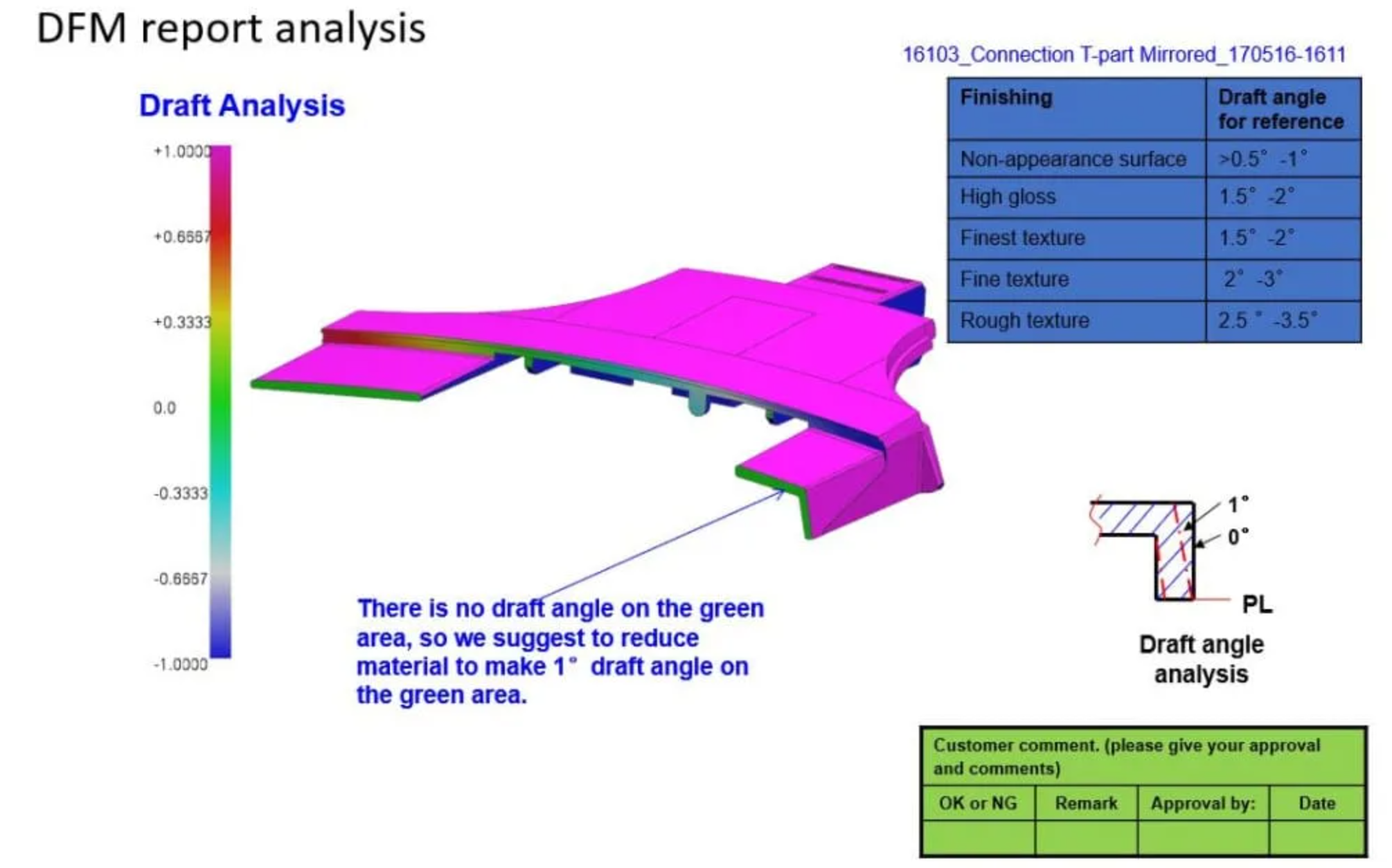
The reason why DFM is crucial for mould projects is that it can bring significant cost, time and quality benefits.
Firstly, the cost of modifying 3D drawings is much lower than modifying already machined moulds. DFM can help avoid costly and time-consuming rework in the
later stage, directly saving project expenses. Secondly, by identifying and resolving potential manufacturing bottlenecks in advance, DFM can significantly reduce
the number of repeated mould trials and modifications after mould opening, thereby accelerating product delivery.
Moreover, DFM usually combines mould flow analysis to predict the filling process of plastic in the mould, ensuring the strength, appearance and dimensional
stability of the final part. Finally, by optimizing the mould structure and simplifying the reverse processing, DFM can effectively control the overall cost of the
mould while meeting quality requirements.

0086 0755 23170739
0086-0755-24325235
ciky@hainamould.com
3rd Floor Building B1 Lijincheng , Longhua Street, Longhua District, Shenzhen, Gongdong ,China 518109


Copyright 2026 Hainamould.com All rights reserved.
-
 0086 0755 23170739
-
 Facebook
-
 WhatsApp
-
 LinkedIn
-
 TOP
TOP