
Injection molding
In the family of injection molding machines, the horizontal type is undoubtedly the "big brother", and its presence can be seen everywhere. But today, I would like to talk about the often overlooked "little brother" - the vertical injection molding machine.
What are the differences between the horizontal and vertical types?
The simplest way to distinguish them: The horizontal type works "on its back", while the vertical type works "standing up".
The clamping device and injection device of the horizontal injection molding machine are in the horizontal direction, and the machine is long and rectangular, occupying a large area. While the two devices of the vertical machine are vertical, the machine is square-shaped and occupies only about half the area of the horizontal machine.
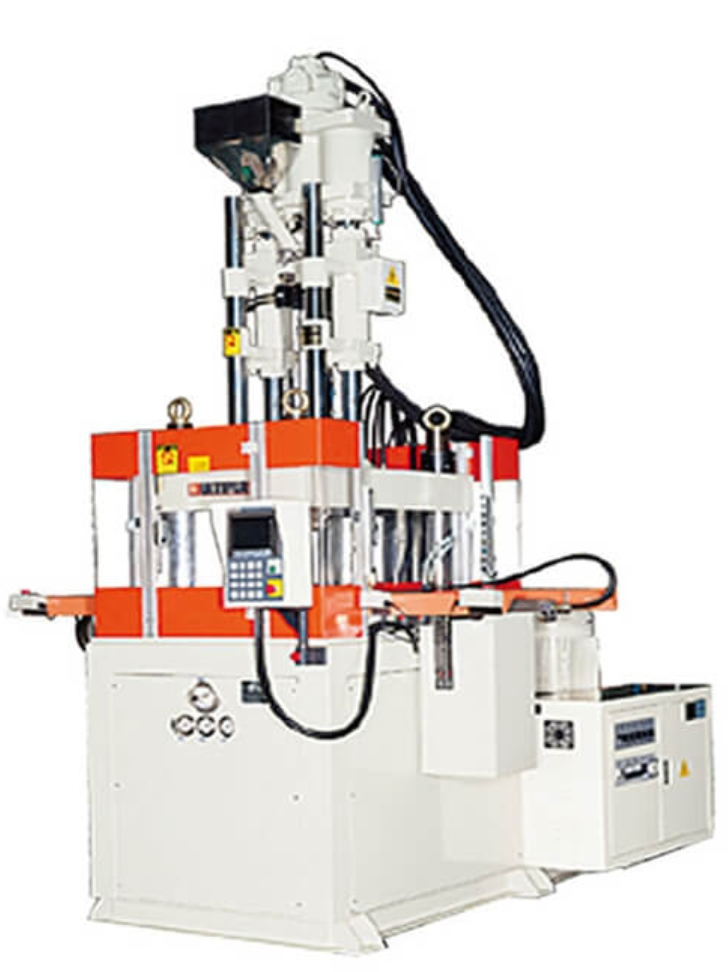
Three core advantages of the vertical machine
First, it saves space.
If your workshop area is limited, the vertical machine is a great choice. With the same space, you can place several machines.
Second, it is strong at producing insert molding.
What is insert molding? It is to put metal screws, wire bundles, and hardware into the mold, and then inject plastic to cover, making the plastic and metal firmly combined into one part.
The mold of the vertical machine is facing upwards, and placing inserts is like putting things into a bowl, which is simple for the operator and does not require them to precisely align. If it is a horizontal machine, the mold is on the side, and placing inserts is prone to falling off.
Therefore, products like USB cables, power plugs, and connectors are mostly made by vertical injection molding machines.
Third, it is easy to pair with automation.
The area around the vertical machine is relatively spacious, making it easy to install mechanical hands and rotating discs for automation devices. One machine paired with one rotating disc can have one upper mold supporting multiple lower molds, with parts placed on this side for inserts, that side for injection, and that side for product removal, performing a cycle of operations, doubling the efficiency.
Which products cannot do without the vertical machine?
Just take a look at the things around you:
• USB plugs for mobile phone chargers
• Various connectors in cars
• Plastic parts with metal inserts
These things are likely made by vertical injection molding machines.
How is the vertical machine market doing?
Many people think that the vertical machine is a niche market, but that's not the case.
In 2025, 180,000 vertical injection molding machines were sold across the country. Moreover, Chinese-made vertical machines have accounted for 65% of the global production - that is to say, every three vertical machines in the world, two are made in China.
Technology is also upgrading. In the past, many small factories still used old-fashioned hydraulic machines, which were noisy and consumed a lot of electricity. Now, servo motors and fully electric models are becoming increasingly popular, accounting for more than 42%. They are quieter, more energy-efficient, and have higher precision.

0086 0755 23170739
0086-0755-24325235
ciky@hainamould.com
Room 1605, 16th Floor, Hongyu Building, No. 495, Donghuan 2nd Road, Longhua Subdistrict, Longhua District, Shenzhen, Gongdong ,China 518109


Copyright 2026 Hainamould.com All rights reserved.
-
 0086 0755 23170739
-
 Facebook
-
 WhatsApp
-
 LinkedIn
-
 TOP
TOP